Many founders would view building a market-leading company as an end goal. For YPO member Yohei Kiguchi, Founder & CEO, LiCUBE, it was a signal to aim higher.
Following an engineering doctorate at Cambridge, Kiguchi set out to build Japan’s largest EV-charging network. In just few short years, he achieved exactly that — scaling it into a billion-dollar, publicly listed business and retiring to the French Riviera at the ripe old age of 32.
By many people’s standards, he had succeeded.
But for Yohei, it didn’t feel that way for long. The luxury lifestyle of Monaco soon began to feel hollow. He craved a fresh challenge. He needed a new project. Something bigger.
That hunger led him to the Deal Tank stage at YPO’s 2025 Global Business Summit with a very different kind of idea — one that moved beyond national scale, was global in scope and guided by a vision for humanity’s future.
The idea that won the room
Kiguchi’s idea ultimately rose to the top of more than 100 submitted pitches, was selected as one of three finalists and was voted the winner by his YPO peers at the summit.
He tells the story with an easy, self-effacing humor. During his presentation, one judge kept asking unusually sharp, in-depth technical questions. Later he learned that the man in the hat and glasses who had spent all that time grilling him was actor, investor and YPO Deal Tank judge Ashton Kutcher. Maybe this meant he had a shot.
— Yohei Kiguchi share
“That was the first moment I realized I might be selected,” he recalls. “I was about to go out and get a coffee. But then I thought, my name might get called. I better stay!”
Kiguchi’s pitch centered on his new startup, LiCUBE — a deep-tech company developing ultra-high-purity lithium materials for frontier industries, from next-generation batteries and semiconductors to space exploration and, longer term, the ultimate end goal of enabling nuclear fusion.
The spark
To understand where that idea came from, we have to go back. Kiguchi founded his previous company in 2015 with the intention of building the largest electric vehicle charging network in Japan — and that is what he did.
“The vision was too small,” he says. “I’m very proud of that company. But I wanted to dream bigger.”
His early success and retiring to Monaco placed him among top-tier founders and CEOs.
In these circles, conversations were not about maintaining success but about defining the next great leaps in human progress.
A conversation with a tech CEO Kiguchi describes as a “mentor” turned to artificial intelligence (AI), quantum computing and nuclear fusion, what Kiguchi calls the three “last human frontiers.”
The question for Kiguchi was not which frontier sounded most ambitious, but where he could meaningfully contribute. AI and quantum computing were exciting, but not his domain. “I’m an energy guy,” he says. “I understand how nuclear fusion works. That’s something I can do.” He is, at heart, an engineer — grounded in energy systems and infrastructure. Fusion, with its promise of near-limitless clean power, felt like a frontier he could help advance.
Curiosity led him to ITER, the international nuclear fusion research project just outside Marseille, France — a two- to three-hour drive from Monaco. While others might have chosen to spend their time relaxing on the Riviera, Kiguchi preferred to make regular trips to the research center, looking, he admits, a little out of place as he pulled up in his Monaco-plated Ferrari to spend the day talking science with ITER’s engineers and physicists. The contrast was not lost on him. “I’m not sure,” he laughs, “but I might have been the only one doing that.”
What he learned surprised him. The bottleneck, he realized, was not simply the complexity of building fusion reactors. It was fuel. Specifically, lithium-6 — a rare isotope required to produce the tritium that powers most fusion reactor designs.
Despite the vast engineering effort poured into reactor design, the supply of lithium-6 was limited and heavily concentrated. Much of the world’s production capability sits in China and Russia, leaving little scalable supply elsewhere. For a technology intended to power the future, the fuel itself is both scarce and strategically constrained.
Enter LiCUBE
Rather than attempting to compete directly in reactor design, Kiguchi turned his attention to the overlooked fuel supply chain.
In Japan, researchers had been working quietly for years on advanced lithium isotope separation technologies. The science was there, but it lacked scale, capital and a clear commercial mandate. Monetization was still 10 to 20 years away — too distant for most investors and institutions.
— Yohei Kiguchi share
For Kiguchi, that was precisely the point. “To win this game,” he says, “first, as a CEO, we define the game. We set the goal, we form the team and we run for that.”
That’s what he did. He committed to funding the entire research team himself, freeing them from the uncertainty of grant cycles and government budgets and giving the work a clear commercial direction.
That decision became LiCUBE — a company built to industrialize the science and bring it to market.
“Starlink before Mars”
Without the rare lithium-6, most fusion designs cannot run. That is the long game.
“We want to eventually make the lithium-6 isotope for nuclear fusion,” Kiguchi says. “That’s a gamechanger for human history.” But the 10–20-year timeline, he admits, is uncertain. “Maybe longer. We can’t wait for that.”
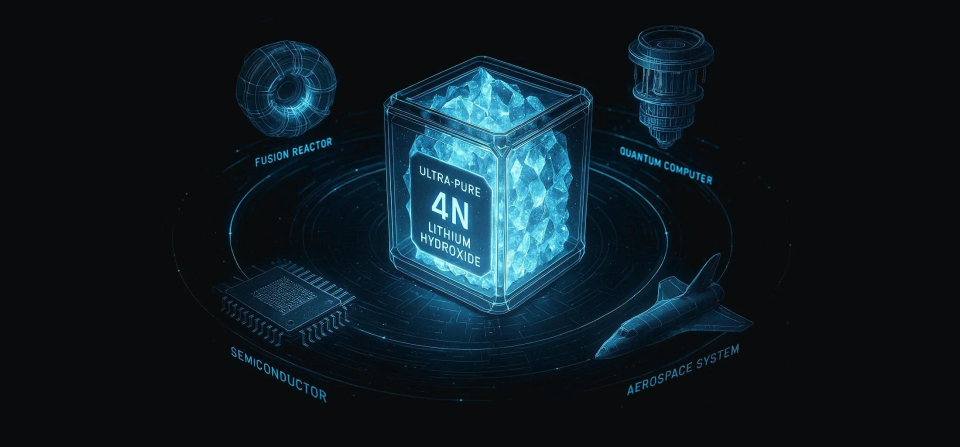
LiCUBE’s current focus is on developing “4N” lithium — meaning 99.99% purity, the “four nines” that give the material its name.
This is the ultra-pure form of lithium used in advanced industries, from solid-state batteries and semiconductors to space systems.
“Like how Elon Musk gave us Starlink before Mars,” he explains. If lithium-6 is Mars, then 4N lithium is Starlink — the interim product that’s building capability, credibility and revenue now, while keeping the long horizon firmly in sight.
That YPO factor
Kiguchi brought this strategy of aiming for lithium-6 as the long-term horizon, while focusing on 4N as the short-term commercial bridge to YPO’s GBS Deal Tank.
GBS’ value to Kiguchi is not just financial. It is the access it brings — to peers, to conversation and to insight that’s candid, technical and grounded in real-world experience.
“YPO people are usually very well connected locally,” he says. “Their value is not only in themselves — it’s having a whole community behind them.” In a sector shaped by geopolitics as much as engineering, that kind of embedded access matters.
In the weeks after the summit, he says he held more than 30 follow-up conversations with YPO members. Some explored investment. Others offered regional and operational insight.
“YPO gives immediate international access,” he adds. “I think that’s a very tangible outcome.”
His advice to other members is simple: Show up and engage. Not every conversation needs to generate immediate capital. The relationships matter. The mission is long-term. He plans to travel to Türkiye in November for GBS 2026.
— Yohei Kiguchi share
And what does a CEO focused on fusion-era materials do to unwind? Kiguchi laughs at the question. Beyond the Monaco drives to fusion labs and long conversations about isotopes, there is a simpler answer.
Mid-interview, he disappears from the screen, returning moments later with his eight-year-old French bulldog, Lon, holding her up to the camera with obvious pride.
For all the talk of lithium-6 and long-term, space age horizons, there is something grounding in that image — a reminder that even those chasing the “last human frontiers” remain, at heart, no different to any of us.
The fusion breakthrough may be decades away. The work, however, has firmly begun.
YPO members can join the GBS 2026 in Istanbul by registering here.