“An alligator ate the power generator.”
Carissa Reiniger was standing onstage at the 2026 YPO Global Impact Summit (GIS) addressing more than 120 chief executives when she was handed a note about a particularly ravenous reptile.
Before the five-day event, the co-chair had identified 17 potential risks of hosting a global gathering on the world’s only fully floating resort on the Amazon River. By the end of their stay, 15 had indeed happened, with the unanticipated alligator’s power trip giving them a bonus 16th.
“The event itself was one of the most complex things that I have ever done,” she recounts, pointing out that the irony of this year’s theme of “Leading Through Complexity” was lost on no one in attendance.
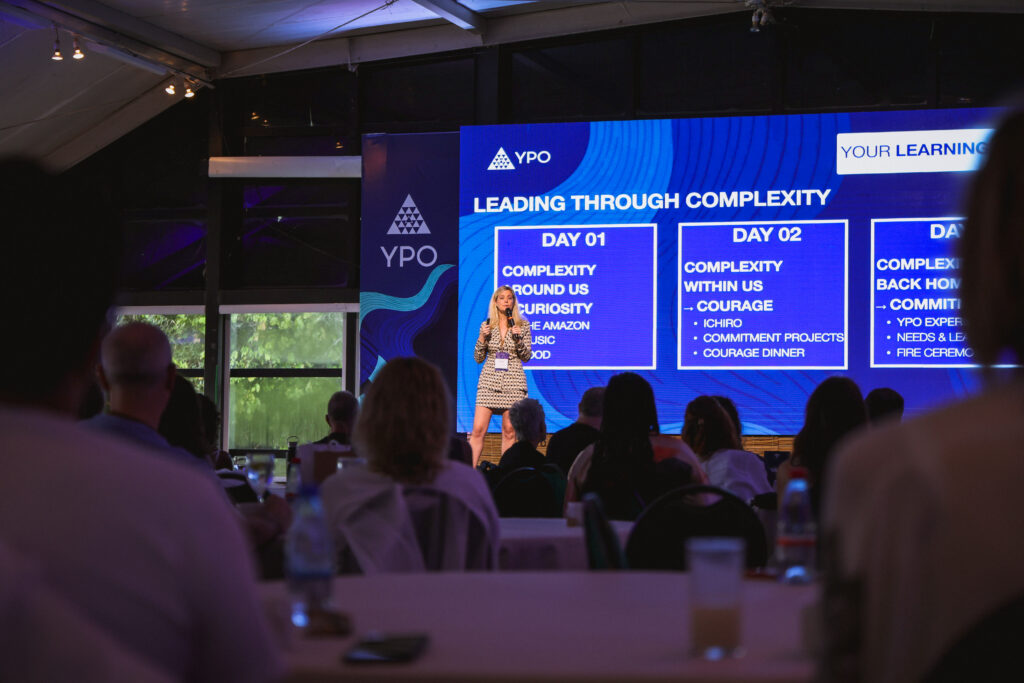
Reiniger, her fellow committee members and attendees found themselves navigating uncertainty at every turn, from logistical challenges and environmental realities to the broader global shifts unfolding beyond the tropical rainforest.
It was a real-life case study in how today’s leaders operate in a world where environmental, economic, political and social realities are increasingly interconnected. Business outcomes and societal outcomes can no longer be compartmentalized, Reiniger argues; impact is no longer a side project or initiative — it is a leadership imperative.
And the leaders who successfully navigate this increasing complexity? They should adopt a different approach and a new set of skills.
Curiosity: Ask questions; shift your perspective
A highlight of GIS 2026 was an evening social at the Amazon Theatre Opera House in Manuas, Brazil, which was, of course, slightly delayed due to a torrential downpour, a closed river crossing and a theater-wide power outage.

When the attendees did arrive, they expected to sit and enjoy a traditional showcase of local musicians. Instead, they were directed onto the stage. There they stood among the musicians and were given prompts to interpret throughout the performance. The exercise was designed around one of the summit’s three big themes: curiosity.
“As leaders who have so much opportunity, knowledge and exposure, we’re still programmed to think a certain way,” says Reiniger. “So, this idea that, even in familiar settings, we still have agency to be curious, to see things differently, to take a different perspective, to sit in a different seat. It was really powerful.”
After decades of leadership being defined by vision, certainty and having all the answers, Reiniger believes leadership today must evolve. The traditional model is less effective in today’s complex world where no one person can fully understand every variable at play.
She points to rising burnout, employee attrition, disengagement and quiet quitting as evidence that many organizations are still operating with leadership assumptions that no longer fit today’s realities. People still want vision and direction, she says, but they also want to be heard, considered and included in the process.
“I think something we’ve not been taught to do for a long time is to ask a lot of questions, to listen and consider a completely different perspective; to not have the answer,” says Reiniger. “Instead of going to a meeting to drive an outcome, go to a meeting to ask all the right questions.”
But curiosity alone isn’t enough.
Courage: Leadership starts where comfort ends
Much of the conversation around impact, sustainability and social responsibility typically happens from the comfort of conference centers and boardrooms. GIS offered something different: the opportunity to live inside the complexity of some of these issues rather than discuss it from a distance.
“I don’t know how much we can learn about our leadership if we’re not uncomfortable,” says Reiniger.
Lessons in courage extended beyond the event’s logistical inconveniences and keynote speakers. Reiniger says she was struck by how many attendees arrived feeling discouraged and questioning whether their efforts to create positive change still mattered in today’s climate.
— Carissa Reiniger share
“‘Maybe it’s not worth it, or maybe the moment has passed,’ were some of the frustrations I heard early on,” says Reiniger. “But by the end, it was more of a ‘no, no, no — we are meant to lead through this moment.”
For Reiniger, courage isn’t about having certainty in the face of complexity. It’s about refusing to disengage because of it. So much of what “impact” focuses on is no longer theoretical, she argues; it’s affecting real world businesses and humans.
“If not now, when? And if not us, who? Who else is going figure this out?” she asks. “My personal belief is that this is not the time for business leaders to back down, it is the time to double down and lead with conviction and moral courage.”
The experience, she says, left her with an increased sense of responsibility and determination.
Commitment: The way you lead is the impact
If curiosity can help today’s leaders understand complexity, and courage allows them to engage with it, commitment determines what they decide to do next.
“We made the mistake of separating out these “impact” issues … like climate over there and DEI over there,” she says. “But these are actually leadership issues now, and you cannot be a leader in 2026 without the capacity to handle complexity.”
That shift in thinking could be the biggest takeaway of the event. For years, many businesses and organizations have treated impact as something separate from the core business: a sub-group, a charitable effort, a ticked box.
Reiniger argues that approach no longer works.
“If impact is an initiative or a conference once a year, we’ve missed the point,” she says.
In fact, if it were up to her, we’d stop thinking about it as “impact” altogether. These aren’t impact issues — they’re leadership issues.
— Carissa Reiniger share
And to the leader who still sees “impact” as a nice-to-have? Reiniger would say this is more than altruism or simply “the right thing to do.” It’s the smarter way to do business.
“There is an economic and business case for figuring out how to lead organizations that create some level of collective return,” she says adding that when employees, customers, suppliers, neighborhoods and communities are well, businesses can thrive.
“I don’t even think you have to sacrifice anything to be a leader who thinks like this. I think you ultimately are going to gain,” she says. “It’s not charity, it’s not philanthropy, it’s not giving back. It just makes sense to make sure your stakeholders are OK.”
The conversations don’t stop here.
If you’re a YPO member interested in joining the Global Impact Summit 2027, learn more. >>>