With tentree, he sells the promise of impact. With veritree, he’s ensuring those efforts take root.
The business of impact hinges on idealism. When you round up your total at the grocery store to contribute the spare change to a good cause, you want to believe you’ve done your part to make the world a better place.
But an unfortunate reality of the impact economy is that follow-through can often fall short.
“I’m a believer that there is way more waste in this space than anybody realizes — often not ill-intentioned, but also not delivering the outcomes we all want,” says Derrick Emsley.
As Co-founder and CEO of two companies with missions centered on sustainability, Emsley knows this struggle firsthand. But his unique position also enables him to address the gap between intention and execution on a global scale.
Planting the seeds
Emsley had the eye for impact at an early age. As teens, he and his brother Kalen Emsley started a tree farm in Saskatchewan, planting 150,000 trees to sell carbon offsets to companies. Their contracts totaled more than USD1 million.
After college, they wanted to do more. In 2012, they launched tentree, tying the brand’s identity to direct environmental action. For every item you purchased, they would plant, you guessed it, 10 trees. To date, the company has funded more than 100 million trees across the world.
“We didn’t know anything about apparel, we just knew trees, and we knew that we wanted to connect people with the ability to fund more reforestation,” Emsley says. “We just needed a new vehicle to allow us to do it.”
Tentree’s products (men and women’s apparel, accessories and gear) have been rooted in accessible sustainability from the beginning. The brand uses organic and recycled materials and produces all their offerings in audited factories that meet strict labor standards. With an “Earth-first” mindset, the global lifestyle brand cuts emissions, reduces waste and designs for circularity wherever possible. The goal isn’t perfection but progress at scale. And thanks to their storytelling-focused marketing, their consumers get it.
— Derrick Emsley, Co-founder and CEO, tentree and veritree share
“One of the coolest experiences I’ve had was someone coming up to me when they saw I was wearing tentree,” Emsley recalls. They told him, “‘I love that brand; did you know they plant trees?’ and they could tell me on the spot where theirs had been planted.”
That moment was a powerful reminder of tentree’s influence: the brand was marketable because it was measurable. But as the company matured, so did Emsley’s understanding of impact, and how much was still left to unearth.
Seeing the bigger picture
Emsley credits a childhood immersed in natural resources and farming for the ethos he brings as the leader of tentree. “We always think of ourselves as blue-collar environmentalists. We’re less about preaching, and we’re more about doing.”
As tentree scaled, this mindset led to an uncomfortable realization that they were only focusing on part of the story. “Planting trees is great because it’s a number and an emotional connection that everybody can anchor to,” says Emsley. But it’s an oversimplification, he adds, because what happened after they plant the tree?
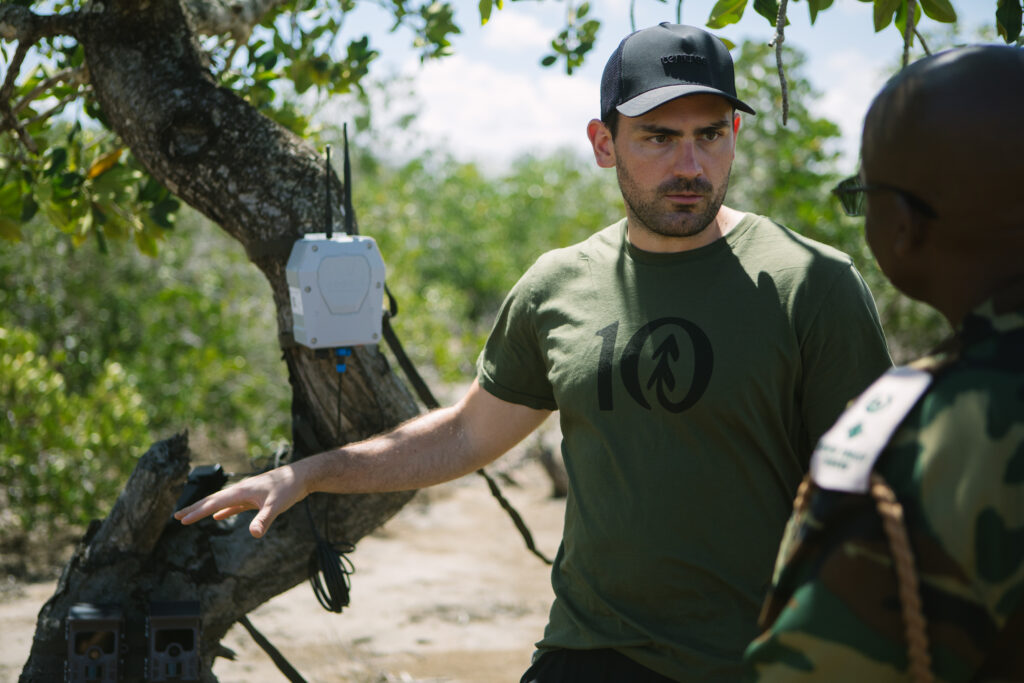
“We started with a very myopic view of the problem tentree had,” Emsley says. “We needed to know, if we fund a tree, did it get planted? Did anybody else claim that tree?”
The deeper they dug, the more complex their problems became and the more questions surfaced: Did the trees survive? How could they monitor them over the long term? How did they know it was the right tree, the right place at the right time? “Our aperture of the problem just continued to expand.”
That expansion led to something larger than tentree itself: veritree.
A standalone platform, veritree combines field data, geospatial tracking and on-the-ground verification to create transparent records from planting through long-term outcomes. It’s the digital accountability infrastructure behind restoration projects like those tentree supports.
The goal, Emlsey says, was to bring auditability, transparency, verifiability and frankly, just integrity to their own work with tentree and eventually, to the impact space at large.
Addressing a shared problem
As veritree developed, it was clear tentree wasn’t alone.
Whether driven by compliance — organizations required to restore land or offset environmental impact as part of their operations — or what Emsley deems charismatic reasons — companies choosing to invest in nature because they believe they should — the challenge was the same: How did anyone know what was working?
“Companies who were already funding reforestation started reaching out,” he says. “They’d say, ‘We have this exact same problem, can we work with you?’”
That pull from the market shifted veritree’s trajectory. No longer just a backend system for one brand, it became a platform designed to support a wide range of partners from financial institutions to travel companies looking to integrate nature into their business models, including Manulife, a global insurance company with extensive forestry and restoration initiatives.
After working with veritree on select projects and seeing the suite of reporting and verification they could provide, Manulife asked to expand its use of the platform across a number of their other global projects.
“It was really cool to see different use cases of where companies see value,” says Emsley. “By no means did we approach [veritree] with this view of, ‘oh, the world needs this!’ But I think as we got into the problem, we realized that there was something much bigger here.”
In 2024 alone, veritree’s partners supported the planting of more than 22 million trees across five countries, provided over 19,556 hours of work and restoring over 3,600 hectares. They’ve launched projects in a diverse range of landscapes including mangroves, agroforestry, kelp, wildfire restoration and more.
Balancing two businesses, one mission
Though Emsley is the CEO of both tentree and veritree, they are truly two separate entities, with totally separate operating teams.
Tentree, now a scaled apparel brand, functions in a familiar market, where the focus is on refinement and efficiency. Veritree, by contrast, is still defining its category and is moving fast, testing ideas and building infrastructure in real time.
Emsley admits the “context switching” can be tough, but he also says that the tension between the two can be an advantage.
“Tentree provides me with operational excellence, that foundational piece,” he says. What we’re building at veritree pushes me to be more growth mentality. Like, where could we take this? What stones are left unturned?”
Of course, another major differentiator between the two is that veritree exists to hold tentree accountable. And the lessons from that dynamic have allowed Emsley to better collaborate with veritree’s clients.
“Tentree has given us so much insight into the value that companies can get from tree planting, that it’s given us a really incredible lens with the conversations we have with companies we work on the veritree side,” he says.
The next phase
For tentree, the path forward will continue to be about scale with integrity. Emsley’s goal is to plant 50-100 million trees every year while stepping into the same conversation as brands like Patagonia. Because despite its size, he says tentree is already punching above its weight, ranking among the top global performers in sustainable materials and practices.
Meanwhile, he’s positioning veritree to become the great connector across the impact economy. Emsley wants to engage with 100,000 businesses.
— Derrick Emsley, Co-founder and CEO, tentree and veritree share
“Every year, there’s over a trillion dollars of philanthropy that gets delivered, and all of these marketplaces operate around the trust that the impact is happening, and the verification behind it,” Emsley says. “Reforestation is just the start of what we’re building. Our vision is to create the infrastructure for trust so that collectively, we can bring much more funding into the space, and collectively, more impact.”
He’s also manifesting a future where nature is embedded into everyday transactions, similar to the small percentages already built into credit cards and platforms like Uber or DoorDash. This way, instead of being an optional add-on, impact becomes a seamless, expected cost of doing business: One that is automated, normalized and of course, verified.