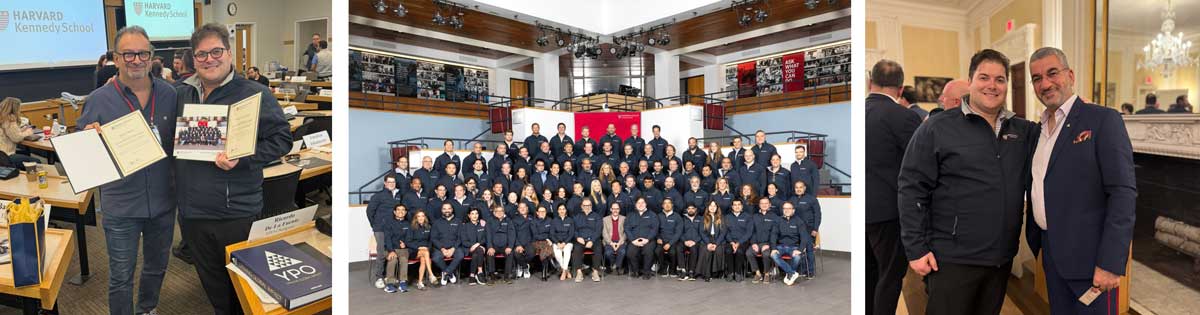
Entrepreneurs, CEOs and executives from more than 40 countries gathered in September at Harvard Kennedy School in Cambridge, Massachusetts, USA, for a YPO executive leadership program led by Christopher Robichaud, the school’s Senior Lecturer in Ethics and Public Policy. Now in its third year, the Harvard Kennedy Leaders Program has helped YPO members refine cross-cultural communication, navigate complex policy challenges and embrace their roles as global leaders equipped to drive meaningful change.
One attendee, Managing Partner at American International Enterprises Inc., Ricardo De La Fuente says, “Leadership is not the power we hold. It is the difference we make in people’s lives and the legacy we leave in the halls of history. The YPO member adds, “Together, let us lead not only for ourselves, not only for our organizations, but for the future of humanity.”
The YPO members traveled to Massachusetts from as far away as Brazil, the Congo and Turkmenistan, to explore creating public value in times of uncertainty, the promise and perils of technology for the common good, and navigating the future of humanity.
Several shared their insights from the 2025 program.
— Ricardo De La Fuente share
Embrace diverse perspectives.
Exposure to diverse global viewpoints sharpens a CEO’s ability to navigate complexity, and true leadership begins with curiosity and listening to understand.
Sunir Chandaria, President and CEO of Chandaria Family Holdings, Inc., speaks to the group’s global representation when he shares that they “compelled me to listen, consider and learn from what ended up being a wide spectrum of perspectives on topics that are of global importance.”
CEOs who purposefully engage with opposing perspectives strengthen their capacity for negotiation, empathy and innovation, explains CEO of Copa Health Shar Najafi-Piper. Leaders, she says, should “look at ways in which we can enhance our listening skills but also ways in which we can understand opposing viewpoints to not only negotiate better in our businesses but ultimately be better humans, which makes us better leaders and enhances our ability to grow and scale our companies.”
The ability to hold space for different perspectives is not a soft skill but a strategic advantage. During the program, Bassel Hamwi explains that they played simulation games, assuming different roles to better understand how society functions under specific scenarios. The CEO of Hamwi Consult adds that the exercise “improved my empathy because I had to experience things from the perspectives of other people that I wouldn’t have otherwise.”
Strengthen real-world leadership through simulation training.
A core teaching strategy at the YPO-Harvard learning event is simulation training, which mirrors the unpredictability of real crises, strengthening a leaders’ ability to respond under pressure and with clarity.
The varying scenarios, De La Fuente says, “help us adapt and cement our values,” adding, it is chaotic, which is “a good practice run for potential challenges.”
The exercises revealed how understanding drives true progress. “The reactions in the classroom as it related to hot topics is actually what’s happening in the world today, and we then had to find ways to work through those differences to still come together and have an understanding of one another,” Najafi-Piper adds.
Iterative learning helps leaders internalize new communication and negotiation techniques. During the exercises, “the group reflected upon what was easy, what was difficult, what was working, what was not, and then went back to re-engage and try some of the new skills to press ahead in the conversation,” Chandaria says.
YPO members benefited from the lived experiences of world leaders who shared their different paths for leading and negotiating with more humanity, including former Prime Minister of New Zealand Jacinda Ardern, former President of Ecuador Jamil Mahuad, U.S. Ambassador to China Nick Burns, former CEO of TIME Nancy Gibbs, past Secretary of Transportation of the United States Anthony Foxx, former Acting Secretary of Treasury of the United States David Lebryk and former United States Ambassador to the United Nations Samantha Power.
Trust and active listening pave the way for difficult conversations.
Building trust among peers creates a foundation for navigating sensitive issues.
“We’ve been able to create precious and powerful goodwill and trust amongst ourselves that enables us to engage in these difficult conversations in a way that is thoughtful and sensitive to the other persons, particularly when we are prepared and keen to preserve the relationship we are forging,” Chandaria says.
— Sunir Chandaria share
In today’s complex, fast-changing environment, adaptability and integrity are essential. For example, during one simulation, participants were placed in four different universes and tasked with creating a survival plan that worked for everyone. “You have to pivot, be flexible, figure out what the opposing team is thinking, build trust with the individuals that you’re working with, build alliances, stay true to your word,” explains Najafi-Piper.
By experiencing inequality and discomfort in simulations, leaders were able to tap into their own vulnerability and compassion. Hamwi described the Simulation of Society (SIMSOC). “We were given a set of circumstances and things to do and communicate across different societies,” he says. The societies ranged from having no chairs, AC or water to being outfitted with luxurious amenities.
Having a balance between conviction and empathy enhances a leader’s credibility.
“Knowing my truth while also trying to remain empathic and sensitive to the other person and their experiences, and how those experiences have created their narrative has continued to help me in finding a peaceful way to be able to have conversations with somebody who has a different viewpoint than I do,” Najafi-Piper notes.
Scale impact through purpose and people.
Leaders need to view business as part of a complex social and geopolitical system.
“It’s taking that journey and looking at your business in the context of society, understanding the different dynamics and the macro forces through policy, economics and different styles of leadership that are required to deal with crisis and emerging challenges,” De La Fuente explains.
Relationships can help accelerate innovation and scale impact. “The ripple effects of what we do are genuine and can grow exponentially … unlocking and enabling the scalability of YPO relationships,” Chandaria says.
— Shar Najafi-Piper share
YPO members all take part in peer groups called ‘forum,’ where enforced confidentiality creates trust and openness that are hard to find elsewhere. The Harvard program maintained the same expectations. Hamwi adds, “The thing that always fascinates me is that when we learn as a forum, how our learning changes us profoundly. We are a lot more vulnerable. We are a lot more open to new ideas and thoughts.”
Some of the most powerful leadership lessons come from learning to understand and uplift one another. “You really get an opportunity to leave what you do behind and come and work with your peers to find ways to understand and listen to each others’ perspectives in order to accomplish one common goal,” Najafi-Piper says.
YPO members are invited to join the 2026 cohort of leaders and thinkers at the Harvard Kennedy School this 13-18 September. Get more information and register here.