Some challenges are too large for governments, businesses or nonprofits to solve alone. China’s growing dental health crisis among senior citizens is one of them.
With an aging population and widespread oral health issues, millions of older Chinese face declining nutrition, reduced social engagement and diminished quality of life. Traditional approaches through public health campaigns and corporate philanthropy have struggled to address the scale of the problem.
MedAsian, a Hong Kong-founded healthcare advisory company, took a different approach. Rather than treating the issue as a medical problem alone, it built an ecosystem of partners capable of addressing clinical, social and public trust barriers at the same time.
Working alongside the Shanghai Elderly Foundation and global oral care solutions leader Straumann Group, MedAsian launched the Smile Ambassadors initiative, a public-private partnership designed to improve awareness of dental implantology, expand access to care and ultimately improve the lives of senior citizens.
The result is a case study in how leaders can align government priorities, commercial interests and public needs to create measurable social impact.
An overlooked epidemic
According to MedAsian, 86% of China’s senior citizens suffer from untreated oral health issues. Tooth loss is particularly prevalent among older adults.
“People between 60 to 74, 80.5% of them have lost teeth,” notes YPO member Michael Ma, CEO of MedAsian.
Among those aged 65 to 74, many have already lost six or seven teeth, while “4.5% of them are totally without teeth,” he adds.
While dental implants have become increasingly common in developed markets, adoption in China remains limited to wealthier populations. Many seniors rely on removable dentures that often reduce comfort and quality of life.
“Before 2023, implantology was not as popular as it is today in China,” says Ma. “Only a few people, especially in the rich sector, approached implantology. Mostly the elderly use the removable retainer.”
For many seniors, the consequences extend beyond oral health. Difficulty eating affects nutrition. Missing teeth reduce confidence. Social isolation often follows.
While the technology exists to solve the problem, access, awareness and trust historically have not.
Building a supportive ecosystem
MedAsian recognized that no single organization could bridge those gaps alone. Rather than launching a standalone corporate initiative, the company focused on assembling complementary partners.
The Shanghai Elderly Foundation provided access to a vast network of seniors and the credibility that comes with public-sector involvement. Straumann Group contributed clinical expertise, technology and funding. MedAsian acted as the architect, connecting stakeholders and coordinating execution.
Success required aligning multiple interests. Government and commercial organizations plus the public’s unmet medical needs create what Ma calls “a very powerful triangle to build up the better living conditions of the people.”
That triangle became the foundation of the Smile Ambassadors initiative.
Beginning in early 2024, MedAsian consulted with government officials, positioning the program as a pilot aligned with Shanghai’s broader public health objectives.
Understanding the rules of the game
One of the most significant lessons from the initiative was the importance of understanding China’s policy environment. According to Ma, entrepreneurs often underestimate the role the government plays in shaping public acceptance and market adoption.
Winning government support was not easy because of, what Ma calls, “the distance” between commerce and government. He needed to convince the government to give him a chance.
— Michael Ma, CEO of MedAsian share
The process required significant discussions, approvals and stakeholder alignment. “It took us almost six to eight months to get everything ready,” he says.
Yet those efforts ultimately created a framework that allowed public trust and private innovation to reinforce one another rather than operate separately.
For Ma, the lesson for business leaders is straightforward. “You must align your commercial vision with government ambition,” he says.
That does not mean abandoning commercial goals but rather identifying where business objectives and public policy priorities intersect. “As a businessperson, how can you help them achieve their ambition? This will help you achieve your commercial ambition,” Ma explains.
Bringing care directly to communities
Once the partnership framework was established, each organization moved quickly to play their part. Straumann mobilized funding and specialist clinicians. The Shanghai Elderly Foundation activated its extensive community network. Volunteers engaged directly with seniors, addressing skepticism and building confidence in the program.
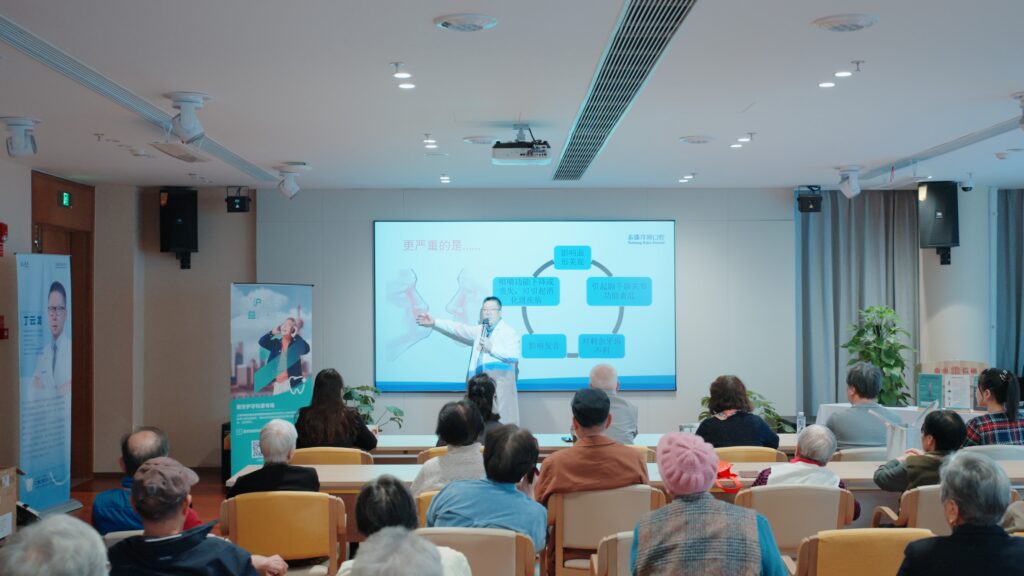
The outreach effort extended across Shanghai through consultations, educational events, screenings and awareness campaigns. “We discussed how implantology could help senior people live better, improve their quality of life,” says Ma.
The initiative went beyond clinical treatment. Educational workshops helped seniors understand modern dental solutions. Community events created opportunities for engagement. Local consultations connected residents directly with professionals. And MedAsian set out to reach seniors in hard-to-reach communities. “We even organized some crews for the senior people on boats on the Huangpu River in Shanghai,” Ma recalls.
The objective was not simply to provide treatment but to create familiarity with implantology and encourage informed decision-making.
Measuring impact beyond dentistry
The Smile Ambassadors initiative produced impressive operational results. By late 2024, the program had conducted thousands of screenings and provided restorative treatments to hundreds of seniors. Community nurses received specialized training to continue oral health education at the neighborhood level.
— Michael Ma. MedAsia CEO share
Yet the most meaningful outcomes were often personal rather than statistical. Data showed substantial improvements in nutritional intake and social participation among treated seniors. Individuals who had struggled with eating, speaking or socializing regained confidence and independence.
The approach generated benefits for every participant. Government agencies advanced healthy aging objectives. Seniors gained access to education and care. Straumann strengthened awareness of implantology and its technology. MedAsian demonstrated the value of coordinated healthcare ecosystems.
As Ma puts it, “It’s a win-win. The government wins the people’s goodwill. For the commercial entity, they win the brands.”
The key was creating value for all stakeholders rather than asking any one participant to shoulder the responsibility alone.
Scaling the model nationally
Shanghai’s success provides a powerful proof of concept, but replicating the model across China presents new challenges.
“China is such a vast country,” says Ma. “From north, south, east, west, and tier one, tier two, tier three, tier five, there is a huge difference.”
Tier systems are unofficially used to classify cities in China based on GDP and population to assess their development and economic potential. MedAsian is now working with broader government stakeholders to expand awareness and access nationwide. The company is also developing training and education centers in lower-tier cities where modern dental services remain less accessible.
“Our mission for this year is to go national,” Ma says.
The ambition reflects broader demographic realities. China’s senior population continues to grow rapidly, increasing demand for healthcare solutions that support healthy aging and quality of life. For MedAsian, the goal is not merely to replicate a program but to scale an ecosystem.
The leadership lesson
The Smile Ambassadors initiative offers a powerful lesson for leaders confronting large-scale social challenges. Complex problems rarely yield to isolated interventions. They require innovative thinking, stakeholder alignment and patience to build trust across organizational boundaries.
MedAsian’s achievement was not simply restoring hundreds of smiles. It was creating a framework through which public institutions, private enterprises, healthcare professionals and community organizations could collaborate around a shared mission.
The initiative demonstrates that meaningful change often begins not with a breakthrough technology or a large donation, but with thoughtful architecture.
As Ma advises entrepreneurs looking to create impact in China, success depends on understanding local realities and adapting accordingly. “Be more creative as an entrepreneur,” he says. “Do things that are more fitting to the local context and the local rules of the game.”
In Shanghai, that philosophy transformed a dental health crisis into a model of collaborative innovation.