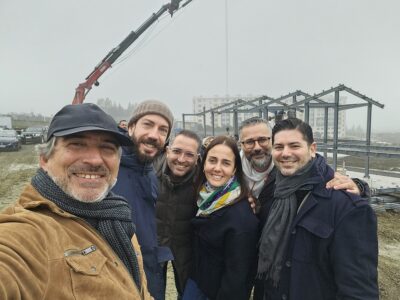
Felipe Ventura is a 2026 YPO Global Impact Award honoree. The award focuses on YPO members making impact outside the organization that is both sustainable and scalable, affecting people, prosperity, peace or our planet.
Felipe Ventura, CEO of Opus Construtech in Minas Gerais, Brazil, always forged his own path.
As a child, he chose competitive horseback jumping over his country’s most beloved sport, soccer. After earning his law degree, he quickly realized that a life spent logging endless hours at the office wasn’t for him. Instead, he followed his grandfather’s footsteps into entrepreneurship. Even as he built his company, Ventura again took the unconventional approach — prioritizing innovation, efficiency and human connection over short-term profits.
“Profit is a consequence,” he says. “When you build trust and connect people, reputation becomes stronger than price — and that’s a better way to do business.”
That better way has paid off for Ventura, a YPO 2026 Global Impact Award honoree.
Not only is he a world champion show jumper, he is also the CEO of a company revolutionizing construction through industrialization, with a relentless focus on drastically reducing material waste to build a more sustainable future.
The impact
When Ventura founded Opus eight years ago with just four employees, the vision centered on innovation, automation and robotics, manufacturing sustainable modules for offices and homes. They pledged to follow the 3R concept — reduce, reuse and recycle — throughout the production chain and “always think about governance structure and doing things right, from the beginning.”
“We are reinventing construction to scale impact, dignity and sustainability where people live and work,” he says.
Opus merges the automotive and construction industries to build steel-structured modules with isothermal panels in less than half the time of traditional builds. “Because we produce our models in an industrial process and plan material usage mathematically, the construction is already more efficient and generates far less waste,” he says.
— Felipe Ventura, CEO of Opus Construtech share
The results are measurable. At Opus, each square meter of modular construction generates 12.5 kg (27.5 lbs.) of waste, while traditional construction generates 86.27 kg (192.35 lbs). Material waste drops from as much as 8% to just 1.8%.
CO² emissions are also lower. According to academic research from the University of Cambridge and Edinburgh Napier University, factory-built homes can produce up to 45% less carbon compared to traditional residential construction methods. To top it off, the sale of recyclables in 2024 covered 134% of the waste management costs at the Betim facility in Minas Gerais, effectively eliminating waste management expenses.
Scaling with purpose
The company’s success at reducing waste and CO² emissions didn’t happen overnight. Ventura says Opus started out focused on solving problems for their clients: building economical, quality modular offices or houses.
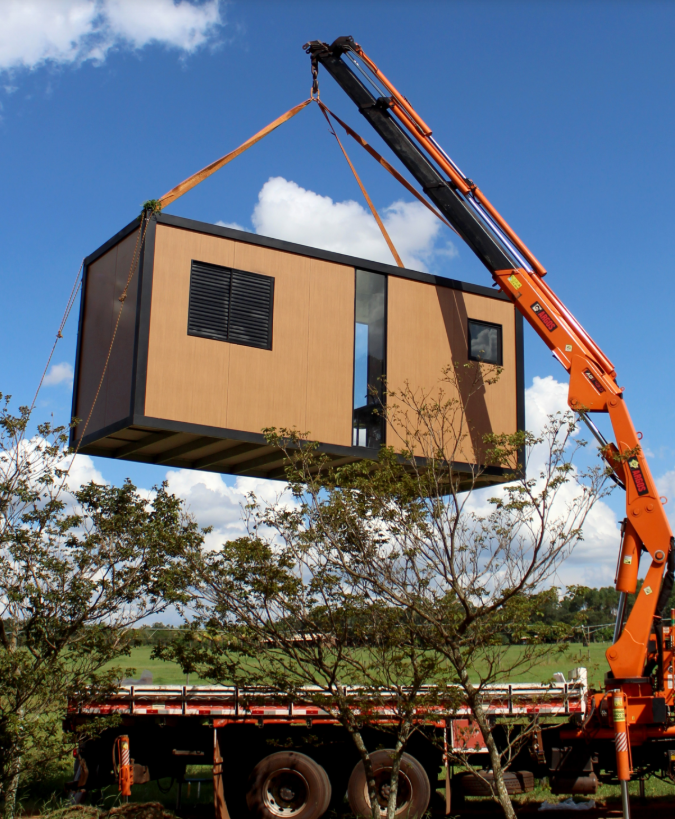
By 2021, the company was growing at an exponential rate — almost 400% in one year. That same year, Opus undertook a huge project — constructing 28 buildings for a mining company in north Brazil. Effectively, they were building a city for more than 4,000 people, and Ventura knew he had to ramp up production.
“We decided to merge with the automotive industry, but we connected this to sustainability,” he says. “When we develop new ways and new materials, we are always asking: How can we make it more sustainable? Not because it’s beautiful or because it’s fancy or because it’s good to say, but because it can be more efficient and better for all of us.”
One of those innovations was creating recyclable plastic flooring that has saved the extraction of 4,479 trees. Partnering with a supplier, Opus repurposes industrial scrap to create a stronger, more durable alternative to wood.
“In the end, the floor is much better because it’s much stronger and the appearance is much better than the wood,” he says. “It’s not like we were looking only for recycled materials. We were looking for hard materials that can last and improve our quality. In the end, it was a sustainable material. I think that’s the magic of everything. You’re not just looking because somebody told you that you need to use sustainable materials; you’re using them because it’s better — for the customer and the environment.”
More than modules
Opus’s commitment extends beyond environmental sustainability. The company is committed to social responsibility, integrating inclusive practices, processes and actions by investing in the community and supporting families in vulnerable regions where they operate.
The investments vary depending on the needs of the community. And while the company does its fair share of charitable donations like food baskets, toys and food, Opus also prioritizes training and courses for community members to create lasting, sustainable impact.
“We are trying to do more than just solve the problem in that moment,” he says. “We want to help them make a better life – long term.”
In Canaã dos Carajás, Brazil, Opus partnered with a local agency to offer training courses for the local community in childcare, elderly care, fabric painting and truck driving. More than 2,500 people were impacted by that work, and more than 300 jobs were generated.
Ventura shares a story about one woman who completed the truck driving program and secured a role at one of Brazil’s largest mining companies. “One month after being hired, she discovered that she had cancer,” he says. “But because she had been hired, she had health insurance, so she could have a treatment.”
The power of YPO
As Opus expanded and his social impact deepened, Ventura joined YPO in 2022, calling it a turning point in his leadership journey.
“YPO was a shift in my career because it was a place where I could share some of the most difficult parts of being a CEO, like managing culture,” he says. “YPO is an amazing opportunity for leaders to connect and see how others are innovating and driving new ways to do business. You can share what you are doing and be inspired through others.”
Human connection
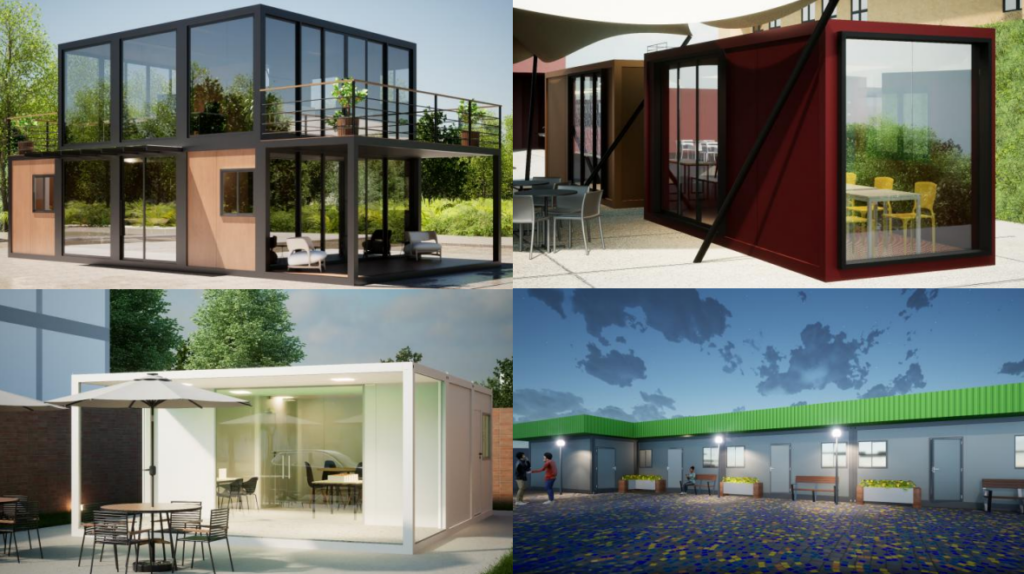
Today, Opus employs 1,200 people and offers 200 modular building variations across Brazil. While the company works solely in Brazil, Ventura says his vision has always stretched far beyond his country.
“We have an amazing opportunity in Brazil, but Opus was built to be a global company,” he says. “We’ll expand at the right time. Within 10 years, that will happen.”
— Felipe Ventura share
No matter how far the company reaches, Ventura is clear he will continue to take the unexpected path and stay grounded in one belief: Community is the true foundation of Opus.
“Companies don’t really exist,” he reflects. “What truly exists are the connections — how people treat one another and how they choose to show up for each other. And community isn’t just the people inside the company. It’s the neighbors around us. In the end, it’s about human connection.”
That belief guides him beyond the doors of Opus.
“I want to build a company that creates real impact where people live and work — without ever losing sight of what matters most: my family, my values and the responsibility we have to improve people’s lives at scale.”