If the opening moments of YPO EDGE in Sydney invited leaders to reconnect with humanity, the first full day asked a sharper question: How do you lead when the ground itself won’t stop shifting?
Across the plenary stage, a pattern emerged. Whether discussing artificial intelligence (AI), culture or geopolitics, speakers returned to one core idea: We are not navigating incremental change. We are navigating a structural reset.
From AI hype to AI at scale
In a candid discussion moderated by REDDS Capital Managing Partner Stephen Ibaraki, three leaders in the AI sector unpacked what it really takes to move AI from pilot to production.
— Brian Glaser, Vice President and Chief Learning Officer at Google share
James Peng, whose company, Pony.ai, operates autonomous fleets in major cities, warns that leaders over-romanticize breakthrough moments. “People put too much credit in zero-to-one,” he says. The real challenge, he explains, lies in the leap “from one to 10, or from 10 to 100.” In autonomous mobility — where safety, regulation and public trust collide — scale is not a growth tactic; it is the strategy. Pony.ai’s top KPIs this year? “Scale, scale and scale.”
Lucy Guo, founder of creator commerce platform Passes, reinforces that view from the world of AI-native startups. Too many companies build “demo-ready products, not production-ready products.” At 10X volume, early wins look impressive. At 100X, the cracks appear. “AI is only as good as the data that you feed it,” she notes, stressing the importance of reliability layers, strong data and clear confidence thresholds before broad deployment.
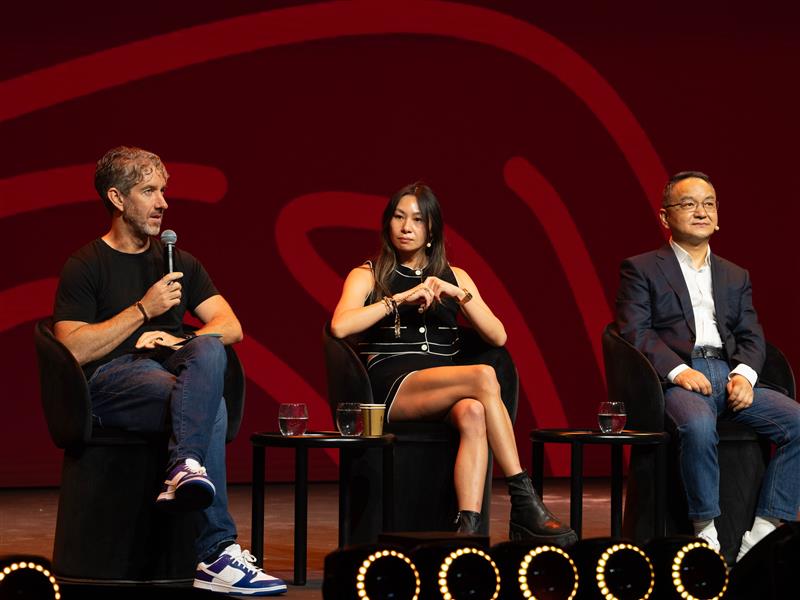
Co-founder of Atlassian, Scott Farquhar pushed the room further, arguing that AI’s impact will not be incremental. “AI is going to transform every single industry,” he says. As intelligence trends toward “the cost of power,” leaders must rethink entire value chains. The opportunity isn’t simply to automate existing processes; it’s to identify what becomes hard when intelligence becomes cheap and build value there.
The throughline was unmistakable: scaling AI is not about adding tools. It’s about redesigning systems.
The bottleneck is at the top
When the conversation turns to leadership, the message sharpened.
“The bottleneck is always at the top of the bottle,” Farquhar says. CEOs themselves are often the constraint. Leaders cannot delegate curiosity; they must use AI tools personally, experiment and model the behaviors they expect.
Guo was equally direct. In today’s environment, she argues, “there’s no excuse” not to be learning and building with AI. In her company, leaders create tools to automate parts of their own organizations. The mindset she values most is flexibility and decision velocity — the ability to pivot without falling into sunk-cost thinking.
Yet speed alone isn’t enough. In safety-critical industries, Pang reminds the audience that “AI is great, but we need to have humans in the loop.” AI can draft, triage and recommend. Leadership still owns the decision.
Across sectors, the conclusion was clear: Technology is accelerating, and leadership behavior must accelerate with it.
A change of eras
Brian Glaser, Google’s Vice President and Chief Learning Officer, zoomed out to frame the broader context. He began with a simple challenge: How many leaders would bet their personal net worth that their current multiyear strategy would remain relevant in 12 months?
Few raised their hands.

Glaser describes the convergence of four forces — environment, demographics, geopolitics and technology — arguing that we are living through a “change of eras” not merely an era of change. Climate risk, shifting labor markets, geopolitical fragmentation and AI-driven disruption are reshaping the operating environment simultaneously.
“What got us here will fail to get us there,” he says.
His answer was continuous reinvention, “picking a direction, not a destination,” running experiments and pivoting quickly. All require three leadership shifts.
— Lucy Guo, Founder of creator commerce platform Passes share
First, move from expert to catalyst. In a world where knowledge is ubiquitous, “it’s the courage to trade having all the answers for having questions.” Vulnerability becomes strength.
Second, move from rewarding perfection to rewarding courage. “In the AI era, courage is the new currency,” Glaser says, warning that “courageous people cannot survive in cowardly systems.” If incentives reward predictability over experimentation, innovation dies quietly.
Third, shift from analyst to storyteller. “Analysts make people think … but storytellers make people act.” In uncertain times, narrative clarity moves teams from threat to possibility.
The takeaway was blunt: Perfect plans for 2030 matter less than having a culture capable of reinventing in real time.
Scanning the horizon
If Glaser focused on internal transformation, Admiral James Stavridis widened the aperture.
Drawing on 37 years in the U.S. Navy and his tenure as NATO’s Supreme Allied Commander, Stavridis mapped geopolitical fault lines across the Middle East, Ukraine, China, Taiwan, the Arctic and Latin America. His assessment was pragmatic: “Hope is not a strategy.”
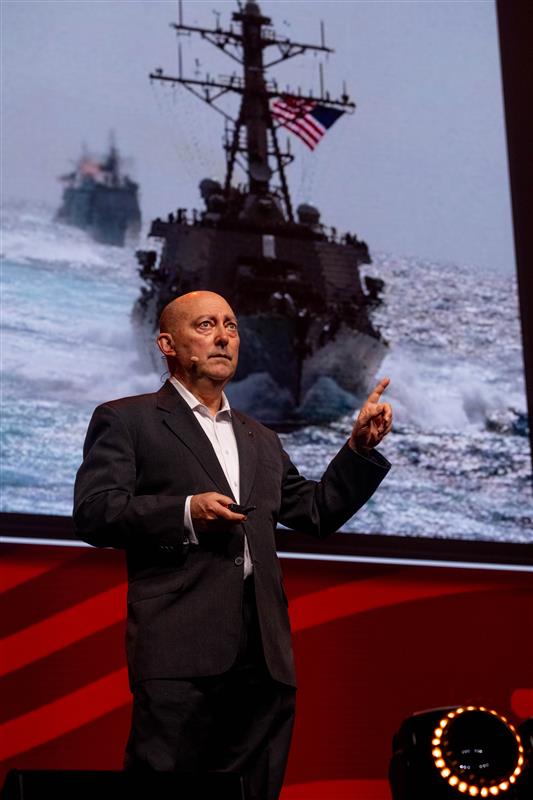
In Ukraine, he dismisses “magical thinking” about Vladimir Putin’s motivations, pointing instead to resources, demographics and power. In U.S.–China relations, he acknowledges tensions while suggesting managed coexistence remains possible. Taiwan, he argues, must become a deterrent “porcupine,” raising the cost of aggression rather than provoking it.
Amid conflict, however, he also saw opportunity: reconstruction in Ukraine, shifting energy dynamics if sanctions ease, rising defense spending, Arctic trade routes and the long-term rise of India and Africa.
Ultimately, he frames volatility as permanent. Invoking the myth of Sisyphus, he remindes leaders that “the boulder will roll down.” Markets will fluctuate. Crises will emerge. The question is whether leaders have “the will … the determination … to put your shoulder to the stone again and again.”
Reinvention as competitive advantage
Taken together, the day’s message was clear.
AI will compress timelines and reshape value chains. Geopolitics will redraw risk. Climate and demographics will alter labor and capital flows. Stability is no longer the baseline.
In this environment, advantage does not come from certainty. It comes from adaptability — from culture that rewards courage, leaders who act as catalysts and organizations that treat experimentation as discipline.
EDGE’s first day did not offer easy answers. It offered something more enduring: a leadership posture for a world in motion.
The future will not be predicted.
It will be built — by those willing to scale, to reinvent and to push the stone forward, again and again.
EDGE is YPO’s premier thought leadership annual event. For three days in Sydney, more than 1,100 chief executives from 66 countries will convene for a transformative experience with dynamic sessions, hands-on experimentation and immersive networking experiences. EDGE fosters a culture of trust, respect and inclusiveness, where global leaders emerge with solutions to drive change and help shape our collective future. YPO EDGE is exclusively for YPO members. Learn more about EDGE.