When Olatomiwa Williams was a teenager in Lagos, Nigeria, she overheard two men speaking about computer science, predicting it would change the world. That brief encounter made a lasting impact on her career trajectory.
“I remember thinking, I need to be super good at math so I can study computer science,” she says. “That conversation opened my mind to what technology could do.”
Now, as Chief Growth & AI Officer for Microsoft in the Middle East and Africa, Williams is at the forefront of digital transformation, leading with vision and empathy.
And through her Uzemi Technology Empowerment Initiative, a nonprofit dedicated to bridging the gender gap in leadership positions across the technology industry, she’s ensuring that other women in tech don’t have to rely on a chance conversation to find their own successful path toward leadership.
Climbing the ladder, breaking the mold
Williams’s path wasn’t always linear. After finishing secondary school, she couldn’t immediately gain admission to study computer science at a university. Undeterred, she enrolled at a polytechnic school to pursue her dream another way. And at an early internship, she approached a visiting IT specialist and requested that he help her learn more about computers.
“I was super determined, and I’m grateful I was,” she says. “It took me longer, but I got there.”
Later, when Williams joined Dimension Data (now known as NTT DATA), she worked on large-scale IT projects including migration efforts for Microsoft systems. One of her managers saw her potential and urged her to specialize. She started earning certifications in Microsoft technologies, expanding her expertise and working directly with Microsoft teams. She was then recruited to join the company, eventually rising to become the first woman to serve as country manager for Microsoft Nigeria, and the first Nigerian employee to rise internally to the position.
— Olatomiwa Williams, Chief Growth & AI Officer for Microsoft in the Middle East and Africa share
“Being the first female meant I had to make sure I did the right thing,” she says. “It wasn’t just about me. It was about inspiring other women to see what’s possible.”
She’s led through economic headwinds and rapid currency devaluation, all while keeping her teams motivated, her customers engaged and her own curiosity satiated. When cloud solutions were still in their infancy, she was one of the first in the region to volunteer to dive in, eventually selling one of the first cloud solutions to customers.
“I always really want to be at the forefront of what is new, what is happening,” she says. “And that’s helped me gain more visibility and support from mentors and leaders within the organization.”
AI for good
Now 15 years later, Williams is one of Microsoft’s most influential leaders in the region. In her role as Chief Growth & AI Officer for the Middle East and Africa, she’s focused on helping organizations embrace technology responsibly and sustainably.
She doesn’t view artificial intelligence as a way to replace human capability, rather as a tool to amplify it. And she’s most excited about its impact in driving inclusion and development in Africa.
“AI is such a powerful tool; it has the potential to transform how we live, how we work and how we solve some of the biggest challenges on the continent,” she says. She’s been privy to AI innovations that are helping farmers predict crop yields, doctors detect diseases earlier and small businesses reach new customers,
“But we have to make sure it’s done in a responsible way, with privacy, fairness and ethics at the center,” she cautions. “My role is to help organizations across the region adopt AI responsibly, to unlock growth and also to make sure no one is left behind.”
Mentorship in motion
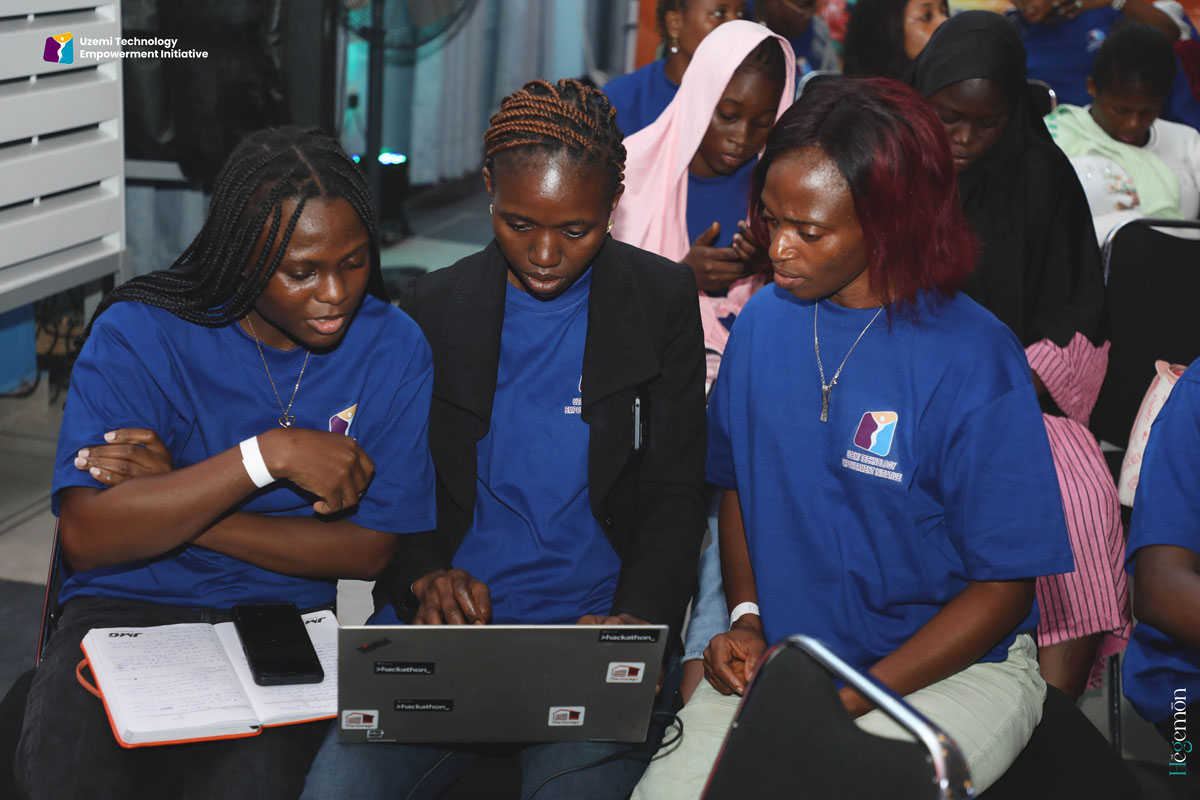
Her advocacy in AI mirrors her commitment to supporting other women in tech. She’s long been a mentor to women within Microsoft, and in 2023, she founded Uzemi to help women in Africa develop digital and leadership skills that can better enable them to take their place in the tech economy.
“I didn’t have many women to look up to in technology when I started; it absolutely was a male-dominated field, and I had to navigate a lot of the challenges on my own,” she says. “So I told myself that when I get to a position of influence, I will do whatever I can to make it easier for other women.”
Through Uzemi, women gain access to mentorship, training and community — the technical and soft skills that can transform potential into leadership. Aspiring women in tech can engage in programs such as the six-month Uzemi Accelerator, as well as the annual Uzemi Leadership Summit in Nigeria, which brings together industry leaders, government officials and aspiring tech professionals for peer-learning, networking and growth.
Empowering others isn’t just an act of generosity for Williams; it’s an investment in innovation.
“We’ve had women who came in with no background in technology and now they are working in tech companies or starting their own businesses,” she says.

Shaping tomorrow, today
Williams’ goal as a leader is to create environments where people feel empowered to challenge norms and innovate without fear. It’s all about unlocking potential.
“I believe people can do more if they’re given the right opportunity, if they’re empowered, if they’re supported,” she says. “But I don’t ask my team to do what I’m not willing to do myself. I roll up my sleeves, get involved when needed, and make sure I’m always available for support.”
— Olatomiwa Williams, Chief Growth & AI Officer for Microsoft in the Middle East and Africa share
This belief system has earned her loyalty and results. “When people feel valued, they go above and beyond,” she adds.
Looking ahead, Williams is focused on shaping a future where innovation and inclusion go hand in hand; where technology serves humanity and leadership means lifting others.
“I want my legacy to be that I used my voice, my influence and my position to empower others — especially women — to achieve their full potential; that I helped drive digital transformation in Africa in a way that’s inclusive and sustainable; and that I inspired the next generation to know that, no matter where you start, your dreams are valid.”