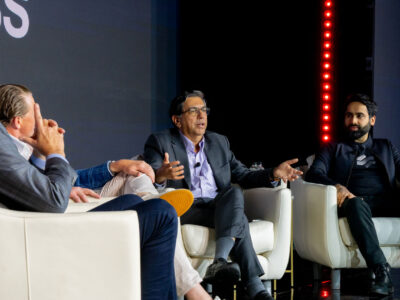
If CEOs want to thrive in today’s world of rapidly changing and unpredictable tariffs, they must think like diplomats, not just operators. That was the clear message at the YPO Global Business Summit’s (GBS) YPO panel discussion on trade and tariffs in the Trump era.
“We’re living in a world of fragmentation now,” Marco Vicenzino, a geopolitical strategist, told the more than 1,000 YPO members from 120 countries gathered in Los Angeles for the second annual summit.
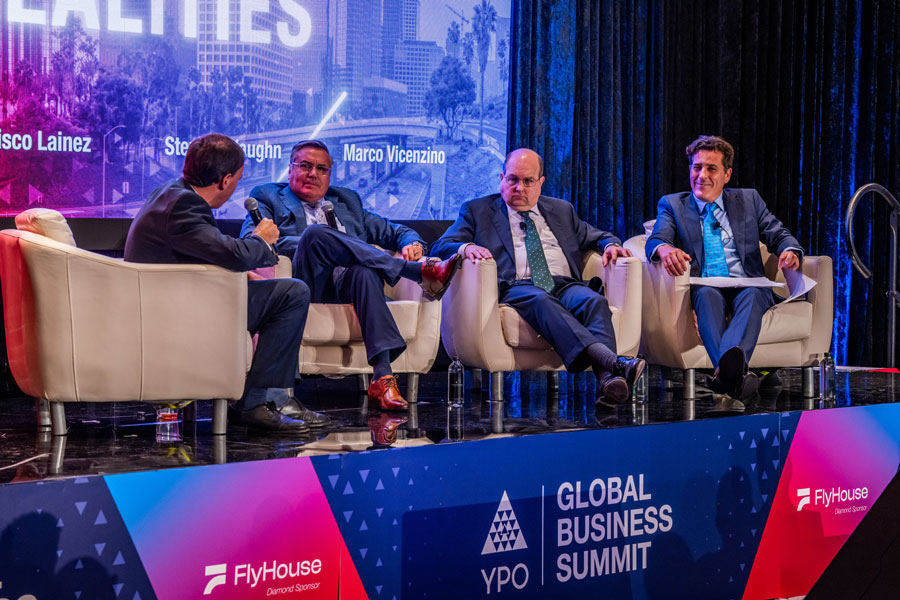
Vicenzino was joined by Stephen Vaughn, the former acting U.S. Trade Representative in President Donald Trump’s first administration, and Francisco Lainez, El Salvador’s Ambassador to the U.S. YPO member Anthony Ginsberg, Managing Director of GinsGlobal Index Funds, moderated the discussion that covered tariffs, shifting global alliances and what chief executives must understand about the new era of “commercial diplomacy.”
The leverage of tariffs
Vaughn opened by explaining why the current U.S. administration has leaned so heavily on tariffs. “This is the biggest labor negotiation in the world,” he says. “The president [Donald Trump] needs you guys to hire more Americans than you want to hire and to pay those Americans more than you want to pay them.”
He described tariffs as levers to rebuild the middle class and restore confidence in an economy destabilized by decades of globalization. “The old middle class that held the country together is collapsing under the pressures of globalization,” he says.
The bottom line is that the administration had to try something, Vaughn says. And tariffs are that something. “It’s not a situation where Washington can just throw up their hands and say there’s nothing we can do,” he says.

Politics over profits
Vicenzino reframed tariffs as symptoms of a deeper structural shift. “We’re not living in a world of de-globalization,” he says. “We’re living in a world of re-globalization — the reconfiguration of global supply chains according to geopolitical fault lines.”
The period from 1990 to 2020 marked a “golden age” for efficiency and open markets. But that era is over, Vicenzino adds. “It’s no longer about profits over politics,” he says. “Now we’re back to politics over profits. You ignore geopolitics at your own risk — because geopolitics will not ignore you.”
For corporate leaders, this means supply-chain decisions are now political decisions. Geographic diversification and “friend-shoring” are becoming core strategy, not contingency planning.
Vaughn and Vicenzino agreed that Washington and Beijing are “inevitably going to move further and further apart.” Both urged executives to assume long-term divergence rather than short-term détente. “There will be pauses,” Vaughn says. “But over time, China and the U.S. are just going to diverge more and more.”
The lean toward diplomacy
From a Latin American perspective, Lainez emphasized diplomacy over confrontation. “Most of the countries in Latin America have not stood up publicly because it’s not convenient with this president,” he says. “They’ve sought diplomatic channels to negotiate, and those that have done that have done quite well.”
Lainez’s broader message to chief executives: Engagement works better than outrage. Businesses operating in politically sensitive regions should maintain open back-channels and focus on constructive solutions.
Follow the data
President Trump puts significant emphasis on data and numerical analysis rather than the perspectives and experiences of business leaders, Vaughn says. When asked why the current administration doesn’t listen to business leaders, he explained that Trump doesn’t have the same interests as the business community.
Essentially, Trump’s goal is to create enough uncertainty on tariffs to have business leaders make more investments in the U.S., Vaughn says. “The U.S. government is no longer going to cover your geopolitical risks. If you want to go into other countries, that’s fine, but it’s your risk,” he says.