At a moment when volatility feels like the new normal, Stanford Professor Dan Klein addressed global chief executives at YPO’s 2025 Global Business Summit in Los Angeles not with data, charts or leadership maxims — but with gibberish.
Within minutes, the CEOs who filled the room were speaking nonsense syllables to strangers and laughing at their own mistakes. And that was the point.
“My goal is to throw you into a little bit of uncertainty,” says Klein, an acclaimed lecturer at Stanford’s Graduate School of Business and longtime faculty member in the university’s theater department and the d.school. “We are in the most uncertain moment in history, and the mindsets we bring to uncertainty matter more than ever.”
Klein, who has taught creativity, collaboration and communication to leaders at Google, Meta, Apple, Cisco, Nike and countless startups, offered YPO members something they rarely get: a visceral experience of adaptability.
What followed was a fast-paced hour of unexpected exercises — and a strikingly practical playbook for executives navigating complexity, rapid change and the relentless unknowns of artificial intelligence (AI), geopolitics and shifting markets.
The first leadership lesson: Get comfortable being uncomfortable
After the room stumbled through its first task — counting to three as a pair without making mistakes — Klein paused and asked how everyone felt.
Awkward. Uncomfortable. Confused. Looking for instructions.
Exactly, he says. That’s what uncertainty feels like. And it’s the leader’s job not to eliminate it — but to model how to move through it.
“We tense up when we fail. It’s instinctive — we brace for judgment or punishment, even when none is coming,” Klein tells the group. “But that tight, defensive posture is the opposite of creativity and connection.”
The alternative? Override that reflex with deceptively simple tools.

Tool #1: “Ta-da!” — celebrating failure on purpose
Every time someone made a mistake in the counting game, they had to throw their arms up like Freddie Mercury at Wembley Stadium and yell: “Ta-da!”
The effect was immediate. The room cracked open. People laughed. Strangers high-fived. The atmosphere softened.
“You have a choice in every moment of failure,” Klein explains. “You can flinch, or you can celebrate. And one response leads to learning, connection and resilience.”
For CEOs, the message was clear: If leaders hide, tense up or self-criticize after mistakes, their teams will too. But leaders who treat failure lightly — without avoiding responsibility — signal psychological safety and accelerate learning.
As Klein puts it: “We learn faster from mistakes than from small successes — if we’re open to them.”
— Dan Klein, Stanford’s Graduate School of Business share
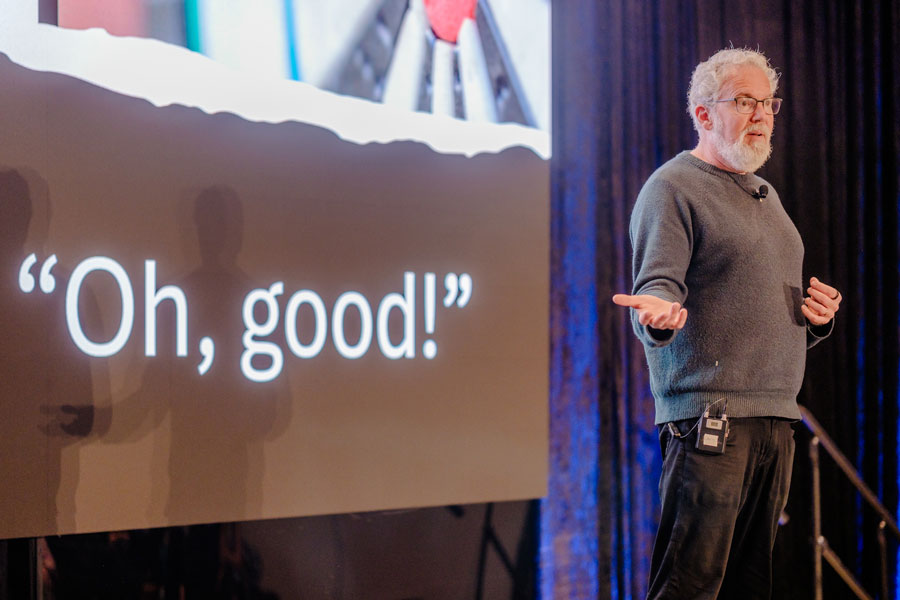
Tool #2: “Oh good” — reframing the unexpected
Next came an exercise with a deceptively profound premise. Whatever someone hands you — an apple, a cardboard box, a flat tire, even a global pandemic — you respond with two words: Oh good.
Then you explain why you needed it.
At first, the exercise seems like play. But for Klein, it’s a mental model for reframing disruption — one leaders can use in real strategic situations.
“We shift from judgment to creativity when we say, ‘Oh good.’ It moves the brain out of protective mode and into generative mode,” he says.
The point is not to pretend that a problem is positive. It’s to ask: What opportunity does this reveal? What resources does this unlock? What might be possible now that wasn’t before?
Klein shared with the audience why this tool is personal to him. As a college student, he suffered a traumatic brain injury after being hit by a drunk driver. Doctors removed part of his skull. His memory fractured. Words disappeared.
At first, every cognitive test filled him with frustration and anger. But then he remembered an improv principle: “Improvisers get what they want because they choose to want what they get.”
So, he tried reframing the accident.
“I said to myself, ‘What if this is luck?’” Klein recalls. “And I began to see the gifts — my family there with me, the hospital I landed in, the year I had to rebuild, and eventually, the career that grew from it.”
His life now, he says, traces back to that moment.
“I’ve learned I can say, ‘Oh good’ to anything. And it changes how I lead, how I teach and how I live.”
Tool #3: “Yes, and” — letting go of control without losing responsibility
The final exercise looked simple — build a story together with a partner by saying, “Remember that time …” But buried inside was a lesson on control.
In one version, participants had to correct each other’s details. In the other, they had to agree with everything and build from it.
“In business, we often think we’re debating details, but we’re actually blocking each other,” Klein explains. “‘Yes, and’ isn’t about agreeing with the content — it’s about building on the contribution.”
Most leaders found the accepting version easier — and more generative. But a meaningful minority preferred disagreement because it gave them more control.
“The practice is learning to let go of control without giving up responsibility. That’s the sweet spot of leading in uncertainty,” he says.
Why these tools matter now
Klein believes the essential leadership capacities of the next decade — adaptability, creativity and resilience — aren’t learned from lectures.
They’re learned through embodied experiences. Exactly what the room got.
“Agility isn’t thinking faster. It’s loosening our grip. It’s making room for imagination. And it happens through connection,” he says.
He points to YPO itself as an example.
“The magic of YPO is connection — real conversations, real vulnerability, real partnership. Connection and creativity are how we’re going to approach every challenge we have.”
Before closing, Klein offered a quote from his mentor, improv legend Keith Johnstone. “People who say yes are rewarded by the adventures they have. People who say no are rewarded by the safety they attain.”
Both are valid choices, says Klein, “But in times like these, safety may not be as safe as it appears. When you choose adventure … you get to enjoy it.”
In an era when AI, geopolitical shifts and market whiplash make long-range planning feel tenuous, leaders need new mental habits — new reflexes.
Klein’s three tools offer a blueprint and don’t require slides, spreadsheets or strategy frameworks — just openness, humor and a willingness to try something new.
Or as Dan Klein might say, “Oh good.”