The financial system is shifting faster than most leaders realize. At the 2025 Global Business Summit in Los Angeles, a panel of early adopters, investors and innovators explored the forces reshaping the industry and shared strategies to stay ahead.
Geoff Pritchard, President at Mindfulness Capital, led discussions with YPO members Thomas Ao, Founder and General Partner of Mindfulness Capital, Peggy Choi, Founder of Craftt, and Jay Steinback, CEO and Co-Founder of yWhales. Together, they broke down what’s happening and why it matters for executives today.

Digital assets are moving from speculation to strategy
The biggest takeaway: Digital assets are no longer a fringe experiment. They’re becoming the new infrastructure of global finance.
Pritchard, also a YPO member, shares that bitcoin has produced a 190,000,000% return since 2008, adding that Michael Saylor, one of the biggest investors in bitcoin, now projects a 30% annual growth for the next 21 years, driven by institutional adoption and constrained supply.
Governments that once resisted digital currency are now approving electronic funds transfers (ETFs), creating clearer frameworks. And clearer rules reduce risk, which speeds up adoption. So really, it’s not a question of whether digital assets will matter; it’s how they’ll fit into your own financial strategy.
“I think the only advantage that you can possibly get right now in bitcoin is just time,” says Steinback. “And if today is your first day ever looking at it, great! That’s over now. Now it’s day two, and how will you manage your thought process?”
The real transformation is happening behind the scenes
Beyond bitcoin, the panel discussed how new infrastructures are being rebuilt underneath global finance including:
- Tokenization: Choi explains how companies are turning traditionally hard-to-trade assets (like private credit) into digital versions that can move quickly and transparently.
- Blockchain as infrastructure: Ao highlights how this technology is quietly becoming a new, faster, more efficient settlement system — the financial equivalent of upgrading from dial-up to fiber.
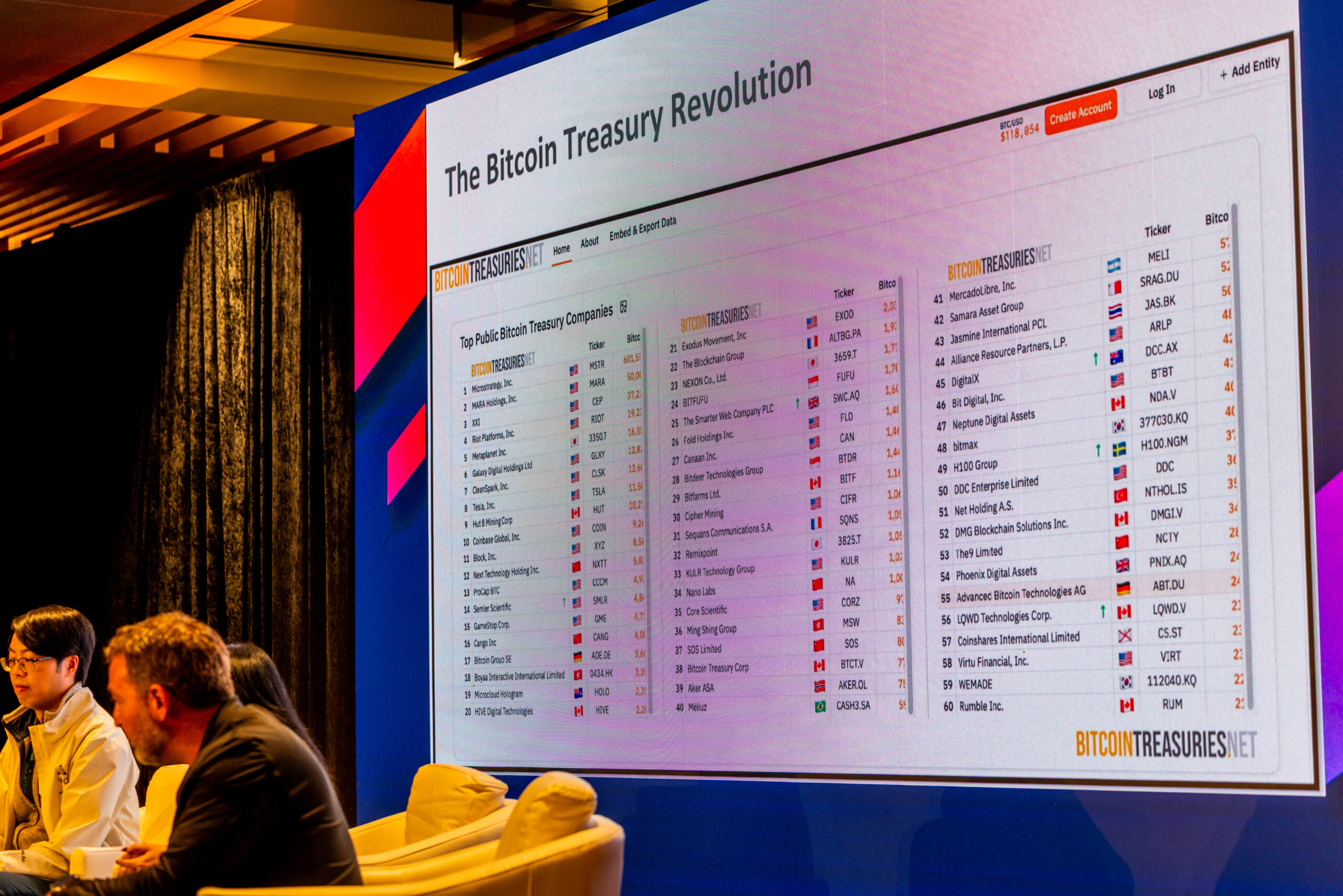
- Digital Asset Treasuries: Steinbeck discusses how some companies are already mixing cash with digital assets to create digital asset treasuries (DATs) that will ideally diversify and strengthen their balance sheets.
The takeaway? Digital finance won’t “look” digital. But it will make financial operations faster, cheaper and more fluid.
“Twenty years ago, only tech companies had websites; now every bakery has a website. I think blockchain will work similarly,” says Ao. “It’s just going to be in the back end. There’s some blockchain codes somewhere in there. They don’t need to know how it works, but it’s working out for them.”
Stablecoins and AI are rewriting how money moves
Stablecoin — a type of cryptocurrency designed to maintain a steady value by being tied to a specific, real-world asset such as the U.S. dollar — emerged as one of the most practical, immediate-use cases.
In the short term, Choi says stablecoins help businesses move money quickly and cheaply across borders. Down the line, they can be programmed to automate payments, including small transactions between AI systems, making business payments more flexible.
— Geoff Pritchard, President, Mindfulness Capital share
“Longer term, from a business standpoint, it means that we can truly think borderless,” she says. “You can work with customers from anywhere, seamlessly.”
AI is transforming trading by analyzing massive amounts of data 24/7 and tailoring strategies to different risk levels. Over time, Ao says his firm has been able to train algorithms faster, creating tools that make small, frequent trades profitable — something humans simply can’t do at the same speed. As money becomes more programmable, AI will increasingly drive transactions, making them faster, smarter and more precise.
What do you do next?
Attendees were encouraged to start small, test stablecoins and explore tokenization opportunities (private credit, supply chain finance and real estate were noted as early movers), educate their board and implement one action in the next six weeks.
As Pritchard emphasizes, “Momentum comes from implementation, not observation.”