
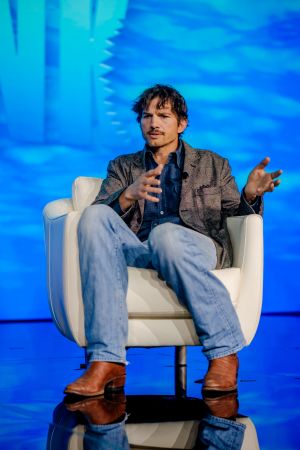
At the YPO Global Business Summit in November, YPO members from around the world gathered for a lively fireside chat with Ashton Kutcher — entrepreneur, tech investor, producer and actor who has quietly built one of the most successful venture portfolios in Silicon Valley.
What followed was a candid conversation on risk, reinvention and building companies for a future that hasn’t arrived yet — but is coming fast.
Kutcher’s journey from a small-town Iowa upbringing to backing tech giants like Airbnb, Uber and OpenAI wasn’t driven by celebrity access — it was driven by work ethic and a relentless curiosity.
“I’ve always been trained to work from 9 to 5 — or more like 9 to midnight,” he tells a packed room of global chief executives with a smile, recalling how he used to sit in his modeling agency’s waiting room all day in New York, hoping for auditions. “I treated it like a job. I showed up every day because I didn’t know any other way.”
That same grit followed him onto the set of That ’70s Show, where he found himself bored between scenes. Instead of coasting, he started learning how the cameras worked, asking questions of the crew, and eventually launching his own production company. From there, his obsession with storytelling turned toward startups — especially those that, like him, were quietly preparing for what came next.
Betting early — and often — on the future
Kutcher’s venture firm, Sound Ventures, has made headline-worthy investments in companies like Square, Skype and Duolingo. But his strategy isn’t just about spotting trends — it’s about spotting people.
“I don’t just want a great founder,” he says. “I want someone I’d work for. Someone who shows up before everyone else and leads by example.”
That includes humility. Kutcher described how one founder was cut from his firm’s consideration because of how they treated the receptionist. “You can tell a lot about someone by how they treat the people around them. That’s nonnegotiable.”
When it comes to early-stage investments, Kutcher says he looks for “founders who have done the work.” One pair he nearly backed had spent six months working as housekeepers before launching their on-demand cleaning startup. “That kind of empathy and domain knowledge — that’s what makes someone worth betting on.”
Culture of disagreement
Inside Sound Ventures, Kutcher champions what he calls an “idea meritocracy.” Investment decisions aren’t made lightly — they’re debated, challenged and recorded.
“The hardest thing isn’t making a decision,” he says. “It’s creating a culture where someone on payroll feels safe enough to boldly disagree with you.”
To ensure those disagreements are genuine and not performative, Sound Ventures tracks who took what position during each investment committee (IC) meeting. “We want people to speak up because they believe it, not just to play devil’s advocate.”
Humility in missed calls
Kutcher was open about the deals he almost missed — like Uber. “When Travis (Kalanick, Uber’s co-founder) first pitched me, it was all about black cars and Lincoln Continentals. The unit economics didn’t make sense,” he admits. But when UberX was introduced — turning drivers into inventory — he knew it was the game-changer.
What allowed him to change his mind? “Ideological flexibility,” he says, referencing Adam Grant’s “Think Again.” Kutcher summarizes, “Conditions change. The best investors adapt.”
The AI moment
Kutcher lit up when talking about artificial intelligence (AI) — a space his firm leaned into early and aggressively. “This is the platform shift,” he says. “And this is the worst AI is ever going to be. It’s only going to get better.”
Sound Ventures took a foundational approach, investing across leading large language model (LLM) and infrastructure players like OpenAI, Anthropic, Stability and Inflection. Now, they’re building a second layer — targeting applications the big players won’t touch due to liability, data privacy or lack of incentive.
— Ashton Kutcher, Entrepreneur, Tech Investor, Producer and Actor share
From customer relationship management (CRM) tools that auto-prioritize your to-do list to cybersecurity layers that govern how teams use AI responsibly, Kutcher describes a future where “everyone will have the greatest tutor, coach or assistant — right in their pocket.”
And his advice to young people (and business leaders) was crystal clear: Automate yourself before someone else does. “Learn how to use these tools to amplify your work. If you refuse, you’re not just behind — you’re replaceable.”
Building for a happier future
At the heart of Kutcher’s vision is a personal mission: to build a future he wants to live in. That means investing in companies solving for material science, energy innovation and sustainable manufacturing — not just convenience tech.
“We’re going to face real questions in the next decade — like do you cool humans or do you cool computers?” he says, referencing the coming energy crunch driven by AI’s massive demand. “We need breakthrough thinking in energy, metals, materials — and it’s coming.”
He envisions a post-knowledge economy where traits like empathy, purpose and creativity become more economically valuable. “If intelligence gets commoditized, then humanity has to show up in other ways.”
Kutcher closed the session with the same grounded clarity he brought to the rest of the chat: “Be curious. Be humble. Build the thing you wish existed. And never be afraid to ask, ‘What am I not understanding here?’”
For global business leaders navigating a rapidly shifting world, that’s a playbook worth remembering.
